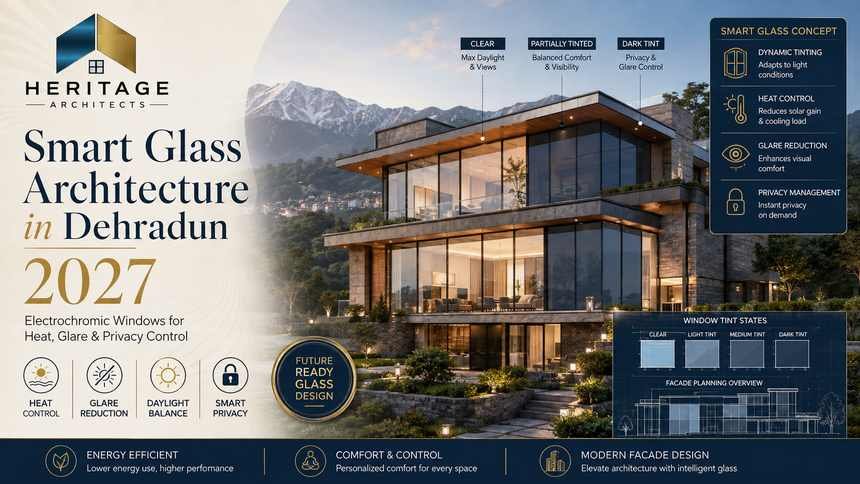
Smart Glass Architecture in Dehradun 2027: Electrochromic Windows for Heat, Glare & Privacy Control
Large glass windows have become one of the defining features of contemporary residential architecture. They bring daylight into interiors, connect living spaces with gardens and mountain views, and make modern homes feel larger and more open.
But glass can also introduce an architectural problem.
The same window that creates a beautiful view in the morning may produce excessive glare in the afternoon, unwanted solar heat during summer and privacy concerns after sunset.
This is where Smart Glass Architecture in Dehradun could become an important part of future-ready residential design in 2027.
Instead of treating glass as a completely static material, electrochromic technology allows selected glazing to change its tint in response to electrical control. This can help regulate how much visible light and solar energy enters a building.
The U.S. General Services Administration describes electrochromic windows as glazing that can dynamically adjust tint to control light, glare and heat entering an interior. Its field evaluations also found significant improvements in glare management and user satisfaction in suitable applications.
For homeowners planning modern residences, villas and premium properties, Smart Glass Architecture in Dehradun creates an opportunity to combine expansive glazing with more intelligent environmental control.
The objective, however, should not be to cover every wall with expensive technology.
Smart glass works best when it is integrated with orientation, shading, window proportions, insulation and climate-responsive architecture.
What Is Smart Glass Architecture?
Smart glass is a broad category of glazing capable of changing one or more optical properties.
Depending on the technology, the glass may alter how much visible light, solar radiation or view passes through it.
In Smart Glass Architecture in Dehradun, electrochromic glazing is particularly interesting because its tint can be electronically controlled.
A conventional fixed glass panel has essentially one permanent optical state.
Electrochromic glazing can move between lighter and darker states.
When the glass becomes darker, it can reduce the amount of direct sunlight and glare entering the room.
When conditions become more comfortable, it can return toward a clearer state and allow more daylight.
This dynamic behaviour makes the window part of the home’s environmental-control strategy rather than merely an opening in the wall.
How Do Electrochromic Windows Work?
Electrochromic glazing contains specialized layers that change optical properties when a small electrical signal is applied.
The process alters the tint of the glass without requiring conventional curtains or blinds to perform every solar-control function.
In Smart Glass Architecture in Dehradun, a control system could potentially respond to:
- Sunlight intensity
- Time of day
- Building orientation
- Indoor conditions
- Occupant preference
- Smart-home schedules
- Daylight sensors
The glass may then move toward an appropriate tint level.
The U.S. Department of Energy identifies electrochromic glazing as one of the more mature dynamic-window technologies and highlights potential energy and occupant-comfort benefits.
Why Smart Glass Architecture in Dehradun Matters for 2027
Dehradun residential architecture must respond to seasonal variation.
Homes can experience warm periods, intense solar exposure, monsoon conditions and cooler winter weather.
Heritage Architects’ existing smart-home guidance similarly identifies warm summers, monsoon rainfall and cooler winters as important local design considerations, while emphasizing shading, natural light, insulation and climate-responsive planning.
This makes Smart Glass Architecture in Dehradun particularly relevant for houses using substantial glazing.
Large windows can improve:
- Daylight
- Views
- Indoor-outdoor connection
- Architectural appearance
- Perception of space
But they can also increase:
- Solar heat gain
- Visual glare
- Cooling demand
- Furniture exposure to sunlight
- Privacy concerns
Dynamic glazing attempts to provide a more flexible balance between these competing requirements.
Heat Gain Is One of the Biggest Problems With Large Windows
Solar radiation passing through glazing can increase indoor temperatures.
This can make spaces uncomfortable and increase air-conditioning loads.
An important window-performance measurement is Solar Heat Gain Coefficient, commonly called SHGC.
SHGC describes the fraction of incident solar energy transmitted into a building through the complete window system.
Lower values generally indicate less solar heat entering through the window. The U.S. Department of Energy notes that SHGC ranges theoretically from 0 to 1, with lower values allowing less solar heat transmission.
For Smart Glass Architecture in Dehradun, electrochromic glazing can alter solar transmission as conditions change rather than remaining at one permanent tint.
Electrochromic Glass Can Help Reduce Solar Heat
Dynamic tinting can become especially useful on façades exposed to strong sunlight.
GSA testing of chromogenic glazing found electrochromic windows significantly reduced window heat gain compared with baseline low-e glazing in the evaluated building. In that particular Denver demonstration, electrochromic glazing reduced window heat gain by approximately 46% relative to the baseline and reduced annual HVAC cooling electricity consumption by about 9%. These figures are project-specific rather than universal savings guarantees.
For Smart Glass Architecture in Dehradun, this shows why dynamic glazing can be worth evaluating for specific heavily glazed spaces.
Actual results will depend on:
- Window orientation
- Window-to-wall ratio
- Glass specification
- Building envelope
- Shading
- Climate
- Air-conditioning system
- Occupant behaviour
- Control strategy
No architect should promise a fixed percentage of savings without project-specific analysis.
Glare Control Can Improve Everyday Comfort
Heat is only one issue.
Large windows can create severe visual glare.
A television opposite a sunny window may become difficult to watch.
A home office near glazing may experience reflections on computer screens.
Direct sunlight can create uncomfortable brightness in living rooms.
Smart Glass Architecture in Dehradun can address this by darkening selected glazing when intense solar conditions occur.
GSA’s more recent electrochromic-window evaluations report significant glare reduction and high user satisfaction in sunny conditions.
This can make smart glass particularly useful for:
- Home offices
- Living rooms
- Double-height spaces
- Reading areas
- Media rooms
- Glass façades
- Large corner windows
Daylight Should Be Controlled, Not Eliminated
The traditional solution to glare is often simple: close the curtain.
But when blinds remain closed throughout the day, the homeowner loses natural light and views.
Artificial lighting may then be used even when daylight is available outside.
Smart Glass Architecture in Dehradun offers another approach.
Instead of creating a binary condition—completely open or completely covered—the glazing can vary its tint.
GSA has found that dynamically controlled electrochromic windows can reduce glare while allowing glazing to return toward clearer states when conditions permit, potentially supporting greater use of natural daylight.
This ability to maintain a connection with the outdoors is one of the strongest architectural benefits of dynamic glazing.
Visible Light Transmittance Matters
Another important glazing metric is Visible Transmittance, or VT.
VT describes how much visible light passes through a window.
A higher VT generally allows more daylight.
The Department of Energy explains that actual residential fenestration products can have widely varying visible-transmittance values, and values below approximately 0.5 can noticeably reduce incoming daylight.
For Smart Glass Architecture in Dehradun, the important factor is that dynamic glazing can offer multiple optical states rather than one permanent VT.
This creates a more responsive façade.
H4: Clearer When Daylight Is Useful
During mild conditions or lower solar intensity, glazing may remain relatively clear.
H5: Darker During Strong Solar Exposure
When glare or heat becomes problematic, the control system can increase tint.
H6: Smart Controls Should Follow Architecture
Automation should not replace intelligent window positioning, external shading or proper façade orientation.
The best Smart Glass Architecture in Dehradun combines passive architecture with dynamic technology.
Does Electrochromic Glass Provide Privacy?
This requires an important clarification.
Electrochromic glazing can become substantially darker and can improve perceived privacy under some conditions.
However, standard electrochromic glass does not necessarily become completely opaque.
Its principal architectural functions are usually solar control, glare control and daylight management.
Therefore, Smart Glass Architecture in Dehradun should not automatically assume that electrochromic tint equals complete visual privacy.
For areas requiring true privacy—such as certain bathrooms, changing areas or private interior partitions—the architect may need to evaluate another switchable-glass technology, dedicated privacy glazing, blinds or physical screening.
Smart Glass and Switchable Privacy Glass Are Not Always the Same
The term “smart glass” includes several technologies.
Electrochromic glass typically changes tint gradually.
Other technologies can create a more translucent or opaque appearance specifically for privacy.
For Smart Glass Architecture in Dehradun, homeowners should therefore identify the real design objective before selecting products.
Ask:
Do you need heat control?
Do you need glare control?
Do you need daylight adjustment?
Or do you need complete visual privacy?
One product may not be the best answer to all four requirements.
Orientation Should Determine Where Smart Glass Is Used
Installing expensive electrochromic glazing on every window may not be practical.
The architect should first study orientation.
East- and west-facing glazing can receive challenging low-angle sunlight at different times of day.
South-facing glazing may require another strategy depending on geometry and shading.
North-facing glazing may have very different solar-control requirements.
For Smart Glass Architecture in Dehradun, each façade should therefore be treated according to actual environmental exposure.
This allows smart glass to be concentrated where it offers the most architectural value.
West-Facing Windows Need Special Attention
Afternoon sun can be particularly difficult to control because of its relatively low angle.
Deep horizontal overhangs that work well against high-angle sunlight may be less effective against low-angle western sun.
A well-designed Smart Glass Architecture in Dehradun strategy could combine dynamic glazing with:
- Vertical fins
- Screens
- Landscape shading
- Recessed windows
- Balconies
- Automated controls
The objective is layered solar protection.
Smart Glass Should Not Replace External Shading
Electrochromic glazing is sophisticated, but architecture should still do the first part of the work.
External shading can stop solar radiation before it reaches the glass.
Heritage Architects already emphasizes overhangs, louvers, balconies, screens and automated shading as part of energy-conscious smart-home planning.
This principle remains important for Smart Glass Architecture in Dehradun.
A well-shaded electrochromic window may perform better architecturally than an oversized unshaded glass wall that relies entirely on technology.
Integrate Smart Glass During the Initial Design Stage
Dynamic glazing should not be introduced after all electrical and architectural drawings are complete.
For Smart Glass Architecture in Dehradun, early coordination can determine:
- Window dimensions
- Glass specification
- Electrical supply
- Control cables
- Sensors
- Automation interfaces
- Wall and ceiling routes
- Control-panel location
- Maintenance access
This helps avoid exposed wires or unnecessary wall cutting later.
Smart-Home Automation Can Control the Glass
Electrochromic windows can potentially become part of a broader smart-home ecosystem.
Depending on the selected system, Smart Glass Architecture in Dehradun may integrate glazing with:
- Lighting controls
- Temperature sensors
- Sunlight sensors
- Smart thermostats
- Motorized shades
- HVAC
- Energy monitoring
- Occupancy sensors
For example, a living-room façade could become darker during strong afternoon sun while internal lighting adjusts automatically according to remaining daylight.
The exact integration depends on product compatibility and system design.
Manual Control Should Still Be Available
Automation is useful, but homeowners should not feel trapped by algorithms.
A good Smart Glass Architecture in Dehradun solution can provide sensible occupant control where technically appropriate.
Users may want a darker setting for watching television or a brighter setting during cloudy conditions.
The smart system should support daily life rather than complicate it.
Smart Glass for Double-Height Living Rooms
Double-height spaces often feature dramatic glazing.
These windows can create some of the most impressive interiors in a luxury residence.
They can also produce substantial heat and glare.
This makes double-height façades one of the more interesting applications for Smart Glass Architecture in Dehradun.
Electrochromic glazing can reduce dependence on tall curtains that are difficult to operate and clean.
However, architects still need to consider insulation, façade orientation and glass area carefully.
Smart Glass for Home Offices
Remote and hybrid work has increased the importance of residential workspaces.
Screen glare is a common problem when home offices are positioned near large windows.
Smart Glass Architecture in Dehradun can allow greater access to daylight while reducing excessive brightness when required.
The desk position, window orientation and internal surface reflectance should also be coordinated.
Good office design should solve glare through multiple strategies rather than technology alone.
Smart Glass for Bedrooms
Bedrooms often need both daylight and privacy.
Dynamic glazing can help manage sunlight, especially during early morning or strong afternoon exposure depending on room orientation.
But homeowners considering Smart Glass Architecture in Dehradun should remember that electrochromic tint may not equal blackout conditions.
Blackout blinds or curtains may still be appropriate where complete darkness is desired for sleeping.
Smart Glass for Bathrooms
Bathrooms present a different challenge.
Privacy is usually more important than solar-control flexibility.
Therefore, standard electrochromic glazing may not always be the correct technology.
A carefully planned Smart Glass Architecture in Dehradun project could instead combine appropriate privacy glazing with solar-control strategies according to the actual window.
Product selection should always follow function.
Smart Glass for Mountain and Landscape Views
One of Dehradun’s architectural advantages is the possibility of attractive landscape and hill views from suitable sites.
Permanent dark tint or constantly closed curtains can weaken this connection.
Dynamic glazing can help preserve views more often.
GSA field studies have highlighted view preservation as a benefit of chromogenic windows, although very dark tint states can alter the appearance of the outside environment.
For Smart Glass Architecture in Dehradun, the architect should therefore balance maximum tint with visual quality.
Window Frames Matter as Much as Glass
A premium electrochromic panel installed in a poorly performing frame will not produce an ideal window system.
Thermal performance depends on both glass and framing.
The Department of Energy recommends attention to insulated glazing, low-emissivity coatings and thermally efficient frames, noting that poorly designed metal frames can increase conductive heat transfer.
Therefore, Smart Glass Architecture in Dehradun should evaluate the complete window assembly.
Important factors include:
- Glass
- Spacer
- Frame
- Thermal break
- Seals
- Installation
- Waterproofing
- Air leakage
Monsoon Detailing Is Important in Dehradun
Smart glass remains part of the external building envelope.
This means installation must also handle rainfall and moisture effectively.
For Smart Glass Architecture in Dehradun, window detailing should consider:
- Flashings
- Sealants
- Drainage paths
- Frame joints
- Sill slopes
- External waterproofing
- Electrical connections
- Maintenance access
A technologically advanced glass system is still vulnerable to poor construction detailing.
Electrical Planning Should Be Concealed From Day One
Electrochromic glazing requires control infrastructure.
If this is planned after plaster and interior finishes are complete, the result can involve exposed wiring or difficult retrofit work.
A future-ready Smart Glass Architecture in Dehradun project should coordinate electrical routes at the drawing stage.
This fits naturally with smart-home architectural planning.
Heritage Architects already emphasizes early infrastructure coordination to avoid exposed wiring, unnecessary cutting and incompatible systems in smart homes.
Can Smart Glass Reduce Air-Conditioning Use?
Potentially.
Reducing solar heat entering through windows can reduce cooling demand.
However, energy savings depend heavily on the building.
GSA’s chromogenic-window evaluation demonstrated reductions in cooling energy in its specific test environment, but these figures should not be directly promised for a Dehradun residence.
For Smart Glass Architecture in Dehradun, the architect should evaluate glazing alongside:
- Wall insulation
- Roof insulation
- Shading
- Orientation
- Air-conditioning efficiency
- Window area
- Occupancy
- Natural ventilation
Smart glass is one component of energy-efficient architecture.
Can Smart Glass Reduce Lighting Energy?
Potentially, but the control strategy matters.
If windows remain permanently dark, artificial lighting demand may increase.
The real opportunity is dynamic daylight control.
When conditions are comfortable, Smart Glass Architecture in Dehradun can allow useful natural light.
When sunlight becomes excessive, tint can increase.
The lighting system can then respond through daylight sensors.
This coordinated approach is more sophisticated than simply selecting very dark fixed glazing.
Smart Glass and Net-Zero Home Design
Dynamic glazing can also form part of a broader net-zero or near-net-zero strategy.
The first principle of an energy-efficient home is reducing unnecessary demand.
For Smart Glass Architecture in Dehradun, managing solar heat gain can contribute to lower cooling loads in appropriate situations.
Rooftop solar can then address a portion of the home’s remaining electrical demand.
The systems should be designed together rather than independently.
Smart Glass and Solar-Powered Homes
A solar-powered smart home can coordinate generation and energy demand.
For example, glazing control can reduce afternoon cooling requirements while solar panels generate electricity.
A sophisticated Smart Glass Architecture in Dehradun concept could integrate:
- Electrochromic windows
- Rooftop solar
- Smart HVAC
- Energy monitoring
- Battery storage
- Automated lighting
- EV charging
The architecture then becomes an interconnected energy system.
What Are the Limitations of Electrochromic Glass?
Smart glass should not be presented as a perfect technology.
Homeowners should understand potential limitations.
Higher Initial Cost
Electrochromic glazing is generally more expensive than conventional residential glass.
DOE has identified cost as one of the important barriers to broader dynamic-window adoption.
Switching Speed
Some electrochromic systems change tint gradually rather than instantly.
Electrical and Controls Requirement
The system needs compatible electrical and control infrastructure.
Product Availability
Not every window fabricator may support every electrochromic system.
Replacement Complexity
Future replacement may require a specialized supplier.
Privacy Limitations
Tint does not always mean complete opacity.
Visual Appearance
Very dark states can affect the appearance of outside views.
These factors should be evaluated before committing to Smart Glass Architecture in Dehradun.
Is Smart Glass Worth the Cost?
The answer depends on where it is used.
Installing electrochromic glass in a small shaded window may offer little value.
Using it on a large premium façade exposed to significant sunlight may provide much stronger functional benefits.
The best Smart Glass Architecture in Dehradun approach is therefore selective.
An architect can prioritize glazing according to:
- Solar exposure
- Window size
- Occupancy
- View importance
- Glare risk
- Cooling load
- Privacy requirements
- Client budget
This provides better value than treating smart glass as a decorative upgrade.
Smart Glass for Renovation Projects
Existing homes may also be candidates for smart glazing.
However, retrofits require careful assessment.
Professionals should review:
- Existing frame condition
- Glass dimensions
- Electrical access
- Waterproofing
- Structural support
- Window orientation
- Automation integration
In some cases, replacing the complete glazing assembly may be more practical than attempting partial modification.
A retrofit Smart Glass Architecture in Dehradun strategy should therefore begin with a site survey.
Common Smart Glass Architecture Mistakes
Mistake 1: Using Smart Glass Everywhere
Technology should be placed where it provides measurable architectural value.
Mistake 2: Ignoring Building Orientation
Different façades experience different solar conditions.
Mistake 3: Assuming Tint Means Complete Privacy
Electrochromic solar-control glazing may remain visually transmissive even when darkened.
Mistake 4: Removing All External Shading
Fixed and dynamic shading can complement one another.
Mistake 5: Planning Electrical Infrastructure Too Late
Smart glazing should be coordinated before finishes.
Mistake 6: Choosing Glass Without Checking Performance Data
SHGC, visible transmittance, U-value and tint states should be evaluated.
Mistake 7: Ignoring Maintenance
Future access and service support matter.
Avoiding these mistakes makes Smart Glass Architecture in Dehradun more practical and reliable.
A Practical Smart Glass Roadmap for Homes in 2027
Step 1: Study Plot Orientation
Identify the façades receiving the strongest solar exposure.
Step 2: Determine Window Requirements
Evaluate daylight, views, ventilation, heat and privacy.
Step 3: Optimize Window Size
Do not oversize glazing simply because dynamic tint is available.
Step 4: Add Passive Shading
Coordinate balconies, chajjas, fins and screens.
Step 5: Evaluate Smart Glass Zones
Identify windows where dynamic glazing can provide meaningful benefits.
Step 6: Review Performance Specifications
Check SHGC, VT, U-value and available tint range.
Step 7: Clarify Privacy Requirements
Determine whether electrochromic glass alone is sufficient.
Step 8: Coordinate Electrical Infrastructure
Plan control wiring, power supply and sensors.
Step 9: Integrate Smart Controls
Connect compatible glazing with lighting, HVAC and automation where useful.
Step 10: Verify Installation Details
Review waterproofing, framing and electrical connections.
This approach allows Smart Glass Architecture in Dehradun to become part of an integrated façade strategy rather than an expensive afterthought.
Why Architects Are Important for Smart Glass Planning
Smart glass affects several aspects of residential architecture.
It influences:
- Elevation design
- Daylighting
- Solar heat
- Interior comfort
- Privacy
- Window proportions
- Electrical services
- Automation
- HVAC
- Energy efficiency
An architect can coordinate these relationships.
For Smart Glass Architecture in Dehradun, this is more valuable than asking a glass supplier to select glazing after construction drawings are complete.
Technology should be part of architecture—not applied independently of it.
Why Heritage Architects for Future-Ready Smart Homes?
Heritage Architects already approaches smart-home architecture as a coordinated combination of spatial planning, natural lighting, electrical infrastructure, shading, security, energy management and future expansion.
This approach is directly relevant to Smart Glass Architecture in Dehradun.
A successful dynamic-glazing project requires the architect to consider both the technology and the physical building around it.
The result should remain beautiful even when the automation is switched off.
FAQs About Smart Glass Architecture in Dehradun
1. What is electrochromic smart glass?
Electrochromic glass changes its tint when electrically controlled, allowing the window to regulate visible light and solar heat more dynamically than conventional fixed glazing.
2. Can electrochromic windows reduce heat?
Yes, dynamic tint can reduce solar radiation entering through glazing. The actual effect depends on product performance, orientation, glass area and building design.
3. Does smart glass completely block sunlight?
Not necessarily. Different products have different tint ranges. Performance should be checked using manufacturer data.
4. Can electrochromic glass control glare?
Yes. Glare reduction is one of the established applications of electrochromic windows, and GSA field studies have documented significant glare-control benefits.
5. Does electrochromic glass provide complete privacy?
Not always. Standard electrochromic glazing usually changes tint rather than becoming fully opaque. Dedicated switchable privacy glass or blinds may be required where complete visual privacy is essential.
6. Can Smart Glass Architecture in Dehradun reduce electricity bills?
It may reduce cooling and lighting loads when properly designed, but actual savings depend on the complete building and usage pattern. No fixed savings percentage should be guaranteed without analysis.
7. Can smart glass connect to home automation?
Many modern systems can integrate with compatible controls, sensors or building-automation platforms, depending on the selected product.
8. Is smart glass suitable for bedrooms?
Yes, especially for solar and glare management, but blackout curtains may still be needed if complete darkness is required.
9. Is smart glass useful for large living-room windows?
Potentially, particularly where large glazing experiences substantial solar exposure or glare.
10. Should smart glass replace architectural shading?
Usually not. Smart Glass Architecture in Dehradun should combine dynamic glazing with good orientation, appropriate window size and passive shading.
Conclusion: Make the Window Respond to the Climate
Windows have traditionally been passive components.
They remain clear whether the sun is gentle or intense.
They admit daylight when it is useful and continue admitting it when it becomes uncomfortable.
Smart Glass Architecture in Dehradun changes that relationship.
Electrochromic windows can allow residential façades to respond more dynamically to changing daylight, glare and solar conditions.
Used intelligently, they can help preserve views, improve visual comfort and reduce unwanted solar heat without forcing homeowners to keep heavy blinds permanently closed.
But smart glass should never become an excuse for poor architecture.
Orientation still matters.
Window size still matters.
External shading still matters.
Insulation, framing and waterproofing still matter.
And true privacy requirements must be understood before the glazing technology is selected.
The strongest Smart Glass Architecture in Dehradun projects will therefore combine passive climate-responsive design with carefully selected dynamic glazing and smart-home controls.
For homeowners planning modern residences in 2027, this approach can turn glass from a static façade material into an active part of the home’s comfort and energy strategy.
Heritage Architects can integrate dynamic glazing, smart-home infrastructure, solar-ready architecture, natural-light planning and sustainable façade design into one coordinated residential concept.




Leave a Reply