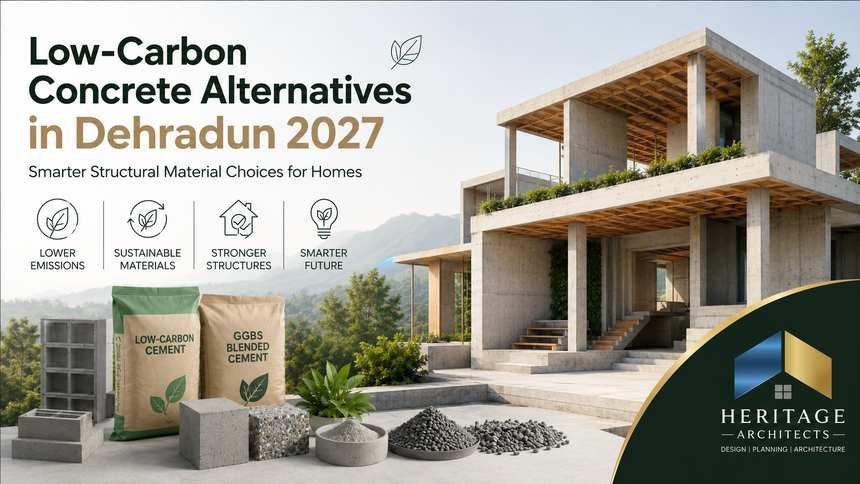
Low-Carbon Concrete Alternatives in Dehradun 2027: Smarter Structural Material Choices for Homes
Concrete is one of the most useful materials in modern residential construction.
Foundations, columns, beams, slabs, staircases, retaining structures and many other building elements depend on it.
But concrete also carries an environmental cost—particularly because conventional Portland cement relies heavily on clinker production.
This creates an important question for homeowners and architects planning construction in 2027:
Can we reduce the carbon impact of concrete without compromising structural safety, durability or construction quality?
That is the objective behind Low-Carbon Concrete Alternatives in Dehradun.
The answer is not necessarily to eliminate reinforced concrete.
Instead, architects, structural engineers, concrete technologists and suppliers can examine whether the project can use lower-clinker blended cements, more efficient concrete mix designs, selected recycled materials and better quantity control.
IIT Madras notes that reducing cement clinker through supplementary materials is one of the major pathways for reducing the carbon impact of concrete. Its research on limestone-calcined-clay cement has reported substantial emissions reductions compared with conventional Portland cement while maintaining appropriate concrete performance.
For Dehradun homes, however, every material decision must remain subordinate to structural safety.
A material is not suitable simply because it is marketed as “green.”
Why Does Conventional Concrete Have a Carbon Footprint?
Concrete itself is a combination of multiple materials.
Typically, it includes:
- Cementitious binder
- Fine aggregate
- Coarse aggregate
- Water
- Admixtures where required
The major carbon concern often comes from cement clinker.
Clinker production involves heating limestone and other raw materials to very high temperatures.
Carbon dioxide is generated from both fuel use and the chemical transformation of limestone during clinker manufacture.
IIT Madras identifies Portland cement clinker production as a major source of global CO₂ emissions and points to clinker reduction as an important decarbonization strategy.
This means Low-Carbon Concrete Alternatives in Dehradun often begin by asking:
Can the required concrete performance be achieved using less clinker?
Low-Carbon Concrete Is Not One Specific Product
Homeowners should be cautious about advertisements suggesting that one new material is automatically “the low-carbon concrete.”
There are several approaches.
Depending on project requirements, Low-Carbon Concrete Alternatives in Dehradun may involve:
- Portland Pozzolana Cement
- Portland Slag Cement
- Calcined-clay-based cement
- Portland calcined clay limestone cement
- Optimized ready-mix concrete
- Recycled aggregate in suitable applications
- More efficient structural design
- Better construction quality and reduced wastage
Often the best strategy combines several of these.
Option 1: Portland Pozzolana Cement – Fly-Ash Based
Portland Pozzolana Cement, commonly called PPC, is already familiar in Indian construction.
BIS lists IS 1489 Part 1 for fly-ash-based Portland Pozzolana Cement.
PPC replaces a portion of conventional clinker-intensive cement content with pozzolanic material.
From a sustainability perspective, this can help reduce dependence on clinker.
PPC may be considered for many normal construction applications when its use is compatible with the structural design, exposure conditions, construction programme and applicable standards.
For Low-Carbon Concrete Alternatives in Dehradun, homeowners should not select PPC solely because it is labelled environmentally friendly.
The structural engineer and concrete supplier need to evaluate actual performance requirements.
Option 2: Portland Slag Cement
Another established blended cement is Portland Slag Cement, or PSC.
BIS recognizes Portland Slag Cement under IS 455.
Slag-based cement incorporates material derived from the iron and steel industry.
This can reduce clinker dependence while creating a useful application for an industrial by-product.
PSC can provide valuable durability properties in appropriate exposure conditions.
However, Low-Carbon Concrete Alternatives in Dehradun should still be selected according to actual project requirements.
A material suitable for one structural environment should not automatically be specified everywhere.
Option 3: Calcined-Clay-Based PPC
Fly ash is not the only pozzolanic option recognized in India.
BIS also lists IS 1489 Part 2 for calcined-clay-based Portland Pozzolana Cement. The standard permits calcined-clay pozzolana, with provisions covering its composition and manufacture.
Calcined clay is becoming increasingly important globally because suitable clay resources can provide another pathway for reducing clinker content.
For Low-Carbon Concrete Alternatives in Dehradun, this expands the material choices available beyond conventional OPC-versus-PPC discussions.
Portland Calcined Clay Limestone Cement and LC3
One of the most significant emerging low-carbon cement technologies is limestone calcined clay cement, widely discussed as LC3.
India has already established a dedicated BIS specification for Portland Calcined Clay Limestone Cement under IS 18189. BIS describes it as a blend involving clinker, calcined clay, limestone and gypsum.
Research led by institutions including IIT Madras has reported that LC3 can reduce CO₂ emissions significantly compared with Ordinary Portland Cement because a much smaller proportion of clinker is required. IIT Madras reported nearly 40% lower CO₂ emissions in its research context.
Updated LC3 technical guidance similarly states that LC3 can lower CO₂ emissions by up to approximately 40% compared with conventional Portland cement while maintaining comparable concrete performance when properly manufactured and applied.
H4: Why Calcined Clay Is Interesting
Clinker production is highly energy and carbon intensive.
Replacing part of that clinker with appropriately processed calcined clay and limestone can reduce the binder’s carbon intensity.
H5: It Is Not Experimental Cement Without Standards
India now has a BIS standard specifically covering Portland calcined clay limestone cement.
H6: Structural Design Still Controls Its Use
The existence of a low-carbon material does not mean it should be substituted into a structural mix without engineering approval.
This distinction is critical for Low-Carbon Concrete Alternatives in Dehradun.
Don’t Confuse Cement With Concrete
This is one of the most common terminology mistakes.
Cement is one component of concrete.
Concrete contains cementitious binder, aggregates, water and potentially admixtures.
Therefore, changing the cement type can influence the carbon impact of concrete, but the final concrete performance still depends on the entire mix.
A responsible Low-Carbon Concrete Alternatives in Dehradun strategy should therefore examine the complete mix rather than simply replacing one cement bag with another.
Reduce Unnecessary Cement Content Through Mix Optimization
More cement does not automatically mean better concrete.
A professional mix should achieve the required:
- Strength
- Workability
- Durability
- Pumpability
- Finish
- Exposure resistance
Using excessive cement simply “to be safe” can increase both cost and embodied carbon.
Concrete mix-proportioning should therefore be performed scientifically.
BIS’s current concrete framework continues to list IS 456:2000 as the Code of Practice for plain and reinforced concrete, and BIS records show it was reviewed again in 2026.
For Low-Carbon Concrete Alternatives in Dehradun, the objective should be achieving specified engineering performance efficiently rather than maximizing binder quantity.
Performance-Based Thinking Is More Useful Than Material Fashion
Suppose two concrete mixes achieve the required structural performance.
One uses significantly more clinker-intensive cement than necessary.
The other achieves the required strength and durability through an optimized blended binder and professionally designed proportions.
The second may have a lower embodied-carbon impact.
This is why Low-Carbon Concrete Alternatives in Dehradun should be evaluated through measurable performance.
The engineer should consider:
- Concrete grade
- Exposure
- Durability
- Structural loads
- Cement type
- Water-cementitious ratio
- Aggregate grading
- Admixtures
- Curing
- Construction conditions
Recycled Aggregate Can Recover Construction Materials
Concrete’s carbon footprint is not limited to cement.
Aggregates also require extraction, processing and transportation.
Construction and demolition waste can potentially provide recycled aggregate for selected applications after proper processing.
India’s Construction and Demolition Waste Management Rules, which came into effect in 2026, strengthen the country’s framework for processing and using C&D-derived materials.
For Low-Carbon Concrete Alternatives in Dehradun, recycled aggregates may therefore become increasingly relevant.
However, recycled aggregate should never be introduced into structural concrete simply because it reduces waste.
Its grading, cleanliness, strength, water absorption and other characteristics need to satisfy applicable specifications.
Recycled Aggregate Does Not Mean Crushed Debris From the Site
There is a major difference between professionally processed recycled aggregate and random demolition debris.
Processed material should go through appropriate:
- Segregation
- Crushing
- Screening
- Contaminant removal
- Testing
For structural Low-Carbon Concrete Alternatives in Dehradun, the structural engineer must approve the proposed material and mix.
Unverified rubble should not be substituted into load-bearing concrete.
Better Structural Design Can Reduce Concrete Quantity
The lowest-carbon cubic metre of concrete is often the one that does not need to be poured.
This makes structural efficiency extremely important.
A rational structural grid can reduce unnecessary:
- Oversized beams
- Excessive slab thickness
- Irregular transfer structures
- Unnecessary retaining elements
However, material reduction must come from engineering optimization—not arbitrary reduction in member sizes.
For Low-Carbon Concrete Alternatives in Dehradun, architect and structural engineer should collaborate early.
A complicated architectural form may require considerably more structural material than a rational layout providing similar usable space.
Dehradun’s Seismic Context Means Safety Comes First
Dehradun and Uttarakhand require serious consideration of earthquake-resistant structural design.
That means low-carbon structural decisions must never involve reducing reinforcement, concrete grade or member dimensions without structural analysis.
A sustainable home that is structurally unsafe is not sustainable.
For Low-Carbon Concrete Alternatives in Dehradun, the sequence should therefore be:
Structural safety → durability → material optimization → carbon reduction
not the reverse.
Sloping Sites Can Increase Concrete Use
Dehradun includes many sites with level differences or slopes.
These may require:
- Retaining walls
- Foundations
- Steps
- Plinth structures
- Drainage infrastructure
Poor site planning can dramatically increase structural concrete quantities.
An architect designing Low-Carbon Concrete Alternatives in Dehradun should therefore consider whether the building can respond more sensitively to site contours instead of unnecessarily fighting the land.
This can potentially reduce excavation, retaining structures and concrete consumption while maintaining safety.
Foundation Design Should Follow Soil Investigation
Large foundations consume substantial concrete.
But reducing foundation dimensions without geotechnical understanding is unsafe.
Soil investigation can help the structural engineer select an appropriate foundation strategy based on actual bearing conditions.
BIS guidance continues to emphasize foundation design based on subsoil data, load and settlement considerations.
For Low-Carbon Concrete Alternatives in Dehradun, good engineering may therefore reduce unnecessary material while also improving structural reliability.
Ready-Mix Concrete Can Improve Quality Control
For suitable residential projects, professionally produced ready-mix concrete can provide greater control over batching and mix consistency than informal volumetric mixing on site.
Consistent batching matters particularly when using optimized low-carbon mixes.
The supplier should understand:
- Specified grade
- Binder type
- Workability
- Transportation time
- Placement requirements
- Testing requirements
BIS currently lists IS 4926 as the code of practice for ready-mixed concrete.
A well-controlled RMC approach can therefore complement Low-Carbon Concrete Alternatives in Dehradun.
Concrete Quality Cannot Be Judged by Colour
A darker or lighter concrete mix is not necessarily stronger or weaker.
Blended cements and supplementary materials can change visual appearance.
Performance should be verified through specifications and testing.
For Low-Carbon Concrete Alternatives in Dehradun, homeowners should rely on engineering records rather than visual assumptions.
Cube Testing Remains Important
Low-carbon concrete still needs quality control.
Concrete strength should be checked according to the project’s applicable testing programme.
BIS’s current IS 456 testing framework includes compressive-strength evaluation and related concrete-quality provisions.
For residential construction, the structural engineer should specify sampling and testing requirements.
Reducing carbon does not mean reducing testing.
Curing Is Critical
Even a sophisticated cement formulation can perform poorly if curing is neglected.
Curing allows cementitious reactions to continue under appropriate moisture and temperature conditions.
Poor curing can reduce performance and durability.
This is particularly important because some blended binder systems may develop properties differently over time compared with conventional high-clinker mixes.
For Low-Carbon Concrete Alternatives in Dehradun, site workmanship remains just as important as material specification.
A premium cement cannot compensate for bad execution.
Concrete Should Be Designed for Durability, Not Only 28-Day Strength
A homeowner may focus only on compressive-strength numbers.
But long-term concrete performance also depends on durability.
Exposure to moisture, chlorides, sulphates or other environmental conditions can influence specification.
The most sustainable concrete is not necessarily the mix with the lowest initial carbon figure.
A concrete element that deteriorates early and needs major repair or replacement can create additional environmental impact.
Therefore, Low-Carbon Concrete Alternatives in Dehradun should optimize both:
embodied carbon + service life.
Waterproofing and Drainage Protect Structural Materials
Dehradun’s monsoon makes moisture management important.
Concrete balconies, terraces, retaining walls and foundations should be protected through appropriate:
- Drainage
- Waterproofing
- Detailing
- Cover
- Construction joints
A durable structure can remain useful for longer.
This directly supports low-carbon architecture because premature repair consumes more materials.
Can Low-Carbon Concrete Save Money?
Sometimes—but not automatically.
Cost depends on:
- Cement availability
- Supplier
- Project quantity
- Transportation
- Mix design
- Admixtures
- Testing
- Construction programme
Some blended materials may be cost competitive, while newer specialized products may have different pricing or supply availability.
For Low-Carbon Concrete Alternatives in Dehradun, architects should compare total installed cost rather than price per bag alone.
A material that requires different curing, admixtures or logistics may change the complete construction cost.
Local Availability Matters
A theoretically excellent low-carbon material may make little sense if it must be transported an extreme distance or cannot be supplied consistently.
Concrete construction depends heavily on supply-chain reliability.
For Dehradun projects, designers should check:
- Cement availability
- RMC supplier capability
- Aggregate source
- Test certificates
- Delivery consistency
This makes Low-Carbon Concrete Alternatives in Dehradun a local procurement question as well as an environmental one.
Ask Suppliers for Actual Product Data
Words such as:
“eco cement,”
“green concrete,”
“environment-friendly concrete”
are not enough.
Architects and engineers should request relevant:
- BIS certification
- Product standard
- Technical data
- Mix design
- Test reports
- Supplier documentation
BIS provides standards for multiple blended cement categories, including PSC, PPC and Portland calcined clay limestone cement.
The objective is evidence-based specification.
Embodied Carbon Should Be Measured, Not Guessed
Embodied carbon describes greenhouse-gas emissions associated with materials and construction across defined life-cycle stages.
India’s Energy Conservation and Sustainable Building Code 2024 now includes embodied-carbon reporting for structural and building-envelope materials within buildings covered by that commercial-building code.
A normal private house should not automatically be described as legally subject to those commercial-code reporting provisions.
However, the methodology provides an important direction for Low-Carbon Concrete Alternatives in Dehradun:
future sustainable design will increasingly compare materials using actual carbon data rather than broad labels.
Concrete Carbon Should Be Compared Per Required Performance
Comparing one kilogram of two cements is useful but incomplete.
The real building requires concrete to perform a structural function.
A more meaningful comparison may therefore consider the carbon required to deliver the specified concrete performance and service life.
For example, if a lower-carbon binder required significantly more material to achieve the same engineered performance, the final result would need proper evaluation.
That is why Low-Carbon Concrete Alternatives in Dehradun should involve architects, structural engineers and concrete specialists together.
Low-Carbon Concrete and Circular Architecture Are Connected
Concrete sustainability does not end when the slab is cast.
Future reuse and recovery matter too.
Construction offcuts and demolition concrete can potentially become material inputs for another application.
A circular Low-Carbon Concrete Alternatives in Dehradun strategy can therefore consider:
- Reduced construction waste
- Recycled aggregate
- Accurate material quantities
- Future material recovery
- Longer service life
The objective is to reduce both initial carbon and future waste.
Common Low-Carbon Concrete Mistakes
Mistake 1: Replacing Cement on Site Without Engineer Approval
Concrete mix design is an engineering task.
Mistake 2: Assuming Every “Green Cement” Is Suitable for Every Structural Element
Application, durability and standards matter.
Mistake 3: Using Unprocessed Demolition Debris as Aggregate
Recycled aggregate requires proper processing and testing.
Mistake 4: Focusing Only on Cement Type
Aggregate, structural efficiency, transportation and wastage also matter.
Mistake 5: Ignoring Curing
Poor site practice can undermine a well-designed concrete mix.
Mistake 6: Assuming More Cement Means More Safety
Concrete should be designed to required performance rather than arbitrarily over-cemented.
Mistake 7: Selecting Materials Without Checking Local Supply
Consistency is critical during structural construction.
Mistake 8: Ignoring Durability
Low initial carbon provides little benefit if premature deterioration requires reconstruction.
Avoiding these mistakes makes Low-Carbon Concrete Alternatives in Dehradun technically credible.
A Practical Low-Carbon Concrete Roadmap for 2027
Step 1: Finalize a Rational Architectural Layout
Avoid unnecessary structural complexity.
Step 2: Complete Geotechnical and Structural Design
Understand actual foundation and load requirements.
Step 3: Establish Concrete Performance Requirements
Define grades, exposure and durability.
Step 4: Evaluate Approved Blended Cements
Compare PPC, PSC, calcined-clay and other applicable BIS-compliant options.
Step 5: Discuss Portland Calcined Clay Limestone Cement
Evaluate IS 18189-compliant products where technically appropriate and locally available.
Step 6: Optimize the Concrete Mix
Avoid unnecessary clinker and cement content while maintaining required performance.
Step 7: Evaluate Recycled Aggregate Carefully
Use only properly processed and tested material in applications approved by the engineer.
Step 8: Select Capable Suppliers
Verify BIS documentation and quality-control systems.
Step 9: Control Batching and Placement
Do not allow arbitrary site modifications to the approved mix.
Step 10: Perform Required Testing
Follow the project engineer’s concrete sampling and strength-verification programme.
Step 11: Cure Properly
Protect concrete during its critical early-age period.
Step 12: Record Material Information
Keep cement, mix-design and test documentation for future reference.
This approach turns Low-Carbon Concrete Alternatives in Dehradun into responsible engineering rather than green marketing.
Why Architects Matter in Low-Carbon Concrete Planning
The structural engineer specifies and verifies structural concrete.
But architecture strongly influences how much concrete the building needs.
Decisions involving:
- Column grids
- Spans
- Basements
- Cantilevers
- Site levels
- Retaining walls
- Structural geometry
can substantially change material quantities.
An architect pursuing Low-Carbon Concrete Alternatives in Dehradun should therefore coordinate early with the structural engineer instead of trying to reduce concrete after the structural system has already been fixed.
Heritage Architects’ existing sustainable-home content already promotes lower-impact materials, locally sourced construction and environmentally responsible residential design in Dehradun.
Low-carbon structural-material planning is a logical extension of that approach.
FAQs About Low-Carbon Concrete Alternatives in Dehradun
1. What is low-carbon concrete?
Low-carbon concrete is concrete designed to reduce embodied greenhouse-gas emissions while still meeting required structural, durability and construction performance.
2. Is PPC a low-carbon alternative to OPC?
PPC reduces reliance on Portland clinker by incorporating pozzolanic material. Its actual carbon benefit depends on the specific product and concrete mix.
3. What is Portland Slag Cement?
PSC is a blended cement incorporating slag and is standardized in India under IS 455.
4. What is LC3 cement?
LC3 generally refers to limestone calcined clay cement, which uses clinker, calcined clay and limestone. India has a dedicated specification for Portland Calcined Clay Limestone Cement under IS 18189.
5. How much carbon can LC3 reduce?
IIT Madras and LC3 technical resources report reductions approaching approximately 40% compared with conventional Portland cement in the systems they studied. Actual project-level savings depend on product, mix, transport and construction.
6. Is low-carbon concrete weaker?
Not inherently. Properly designed blended-cement concrete can achieve required structural performance. The actual mix must be engineered and tested.
7. Can recycled aggregate be used in house construction?
It can be considered for suitable applications when properly processed, tested and approved according to applicable standards and structural requirements.
8. Can we replace OPC with another cement directly at site?
Structural concrete materials should not be changed arbitrarily. The structural engineer and concrete professional should approve the cement and mix design.
9. Does using less cement always make concrete greener?
Reducing unnecessary cement can reduce carbon, but concrete must still satisfy strength, durability and workability requirements.
10. When should low-carbon material planning begin?
Ideally during architectural and structural design, before concrete specifications, suppliers and construction quantities are finalized.
Conclusion: Lower Carbon Should Mean Smarter Concrete, Not Weaker Concrete
Concrete will continue to play an important role in residential construction.
The opportunity for 2027 is not necessarily to remove it.
The opportunity is to use it more intelligently.
Low-Carbon Concrete Alternatives in Dehradun can begin with lower-clinker blended cements such as PPC and PSC.
Calcined-clay technologies and Portland Calcined Clay Limestone Cement introduce another important pathway.
Optimized concrete mixes can reduce unnecessary binder content.
Processed recycled aggregate can preserve material value where technically appropriate.
Rational structural planning can reduce unnecessary concrete quantities.
Better curing and construction quality can extend service life.
And embodied-carbon assessment can help architects compare alternatives with more evidence.
India already has formal standards covering multiple blended cement technologies, including fly-ash PPC, calcined-clay PPC, Portland Slag Cement and Portland Calcined Clay Limestone Cement.
Meanwhile, India’s sustainable-building framework is beginning to formalize embodied-carbon reporting for structural and envelope materials in covered building categories.
For homeowners planning in 2027, this creates a more practical definition of sustainable structural design.




Leave a Reply