
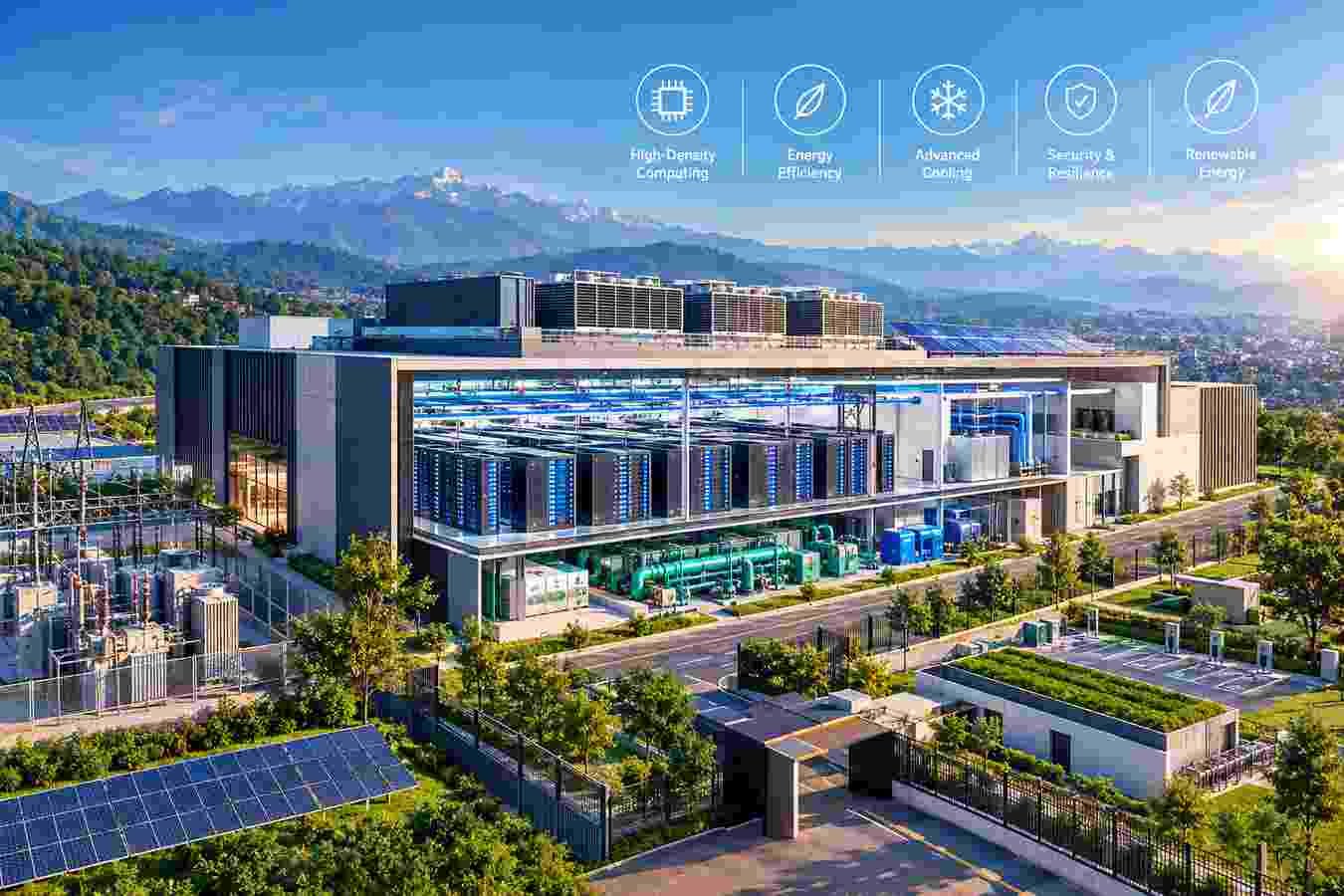
AI-Ready Data Center Architecture in India 2027: Designing High-Density, Energy-Efficient Digital Infrastructure
Artificial intelligence is changing the way digital infrastructure is designed.
Traditional data centres were primarily planned around conventional enterprise servers, cloud workloads and predictable rack densities. AI introduces a different set of architectural requirements: much higher computing density, greater electrical loads, more demanding cooling systems, faster deployment cycles and significantly more emphasis on infrastructure flexibility.
This is why AI-Ready Data Center Architecture in India is becoming an important architectural discipline for the next generation of digital infrastructure.
India’s data centre market is already expanding rapidly. CBRE reported that India’s operational data-centre capacity reached approximately 1,530 MW by September 2025, with around 260 MW of new capacity added during the first nine months of that year. The report also identified AI-driven workloads as an important growth factor and noted increasing interest in Tier-II markets.
At the same time, AI-ready facilities require a different infrastructure strategy from conventional data centres. CBRE has highlighted the need for higher power densities, advanced cooling, stronger floor-loading strategies and infrastructure capable of supporting AI workloads.
For architects, the key question is no longer simply:
“How do we build a data centre?”
It is:
“How do we design a data centre that can support today’s computing loads and tomorrow’s AI infrastructure without becoming obsolete?”
That is the central challenge of AI-Ready Data Center Architecture in India 2027.
What Is AI-Ready Data Center Architecture?
AI-ready architecture refers to the planning of a data-centre facility so that its building, electrical, mechanical, structural, networking and operational systems can accommodate high-density computing and evolving AI workloads.
A conventional data centre may have been designed around relatively moderate rack densities.
An AI-focused facility may require substantially higher density.
That affects almost everything:
- Electrical infrastructure
- Cooling systems
- Floor loading
- Ceiling heights
- Equipment access
- Cable pathways
- Structural grids
- Generator and transformer areas
- Water infrastructure
- Fire protection
- Security
- Maintenance circulation
- Expansion zones
Therefore, AI-Ready Data Center Architecture in India should be approached as a coordinated building-services and infrastructure project rather than a conventional commercial building.
Why AI Is Changing Data Centre Architecture
AI workloads use specialized processors such as GPUs and other accelerators.
These systems can produce much higher heat loads than traditional enterprise computing equipment.
CBRE’s 2025 research noted that AI-focused data centres can require more than twice the power density per server rack compared with traditional facilities, increasing pressure on cooling, floor loading, power distribution and connectivity.
This has major architectural implications.
A server hall designed around yesterday’s rack density may not be capable of efficiently accommodating tomorrow’s AI hardware.
The building therefore needs capacity flexibility.
H4: Architecture Must Anticipate Changing Compute Density
AI hardware is evolving rapidly.
The exact rack configuration that appears advanced in 2027 may become standard or outdated within a few years.
H5: Flexible Infrastructure Becomes More Valuable Than Fixed Infrastructure
Rather than designing every room around one equipment configuration, architects can create adaptable zones, service corridors and infrastructure reserves.
H6: The Building Should Be Able to Change Without Major Reconstruction
This is one of the most important principles of AI-ready planning.
India’s Data Centre Market Is Entering a Higher-Density Phase
India’s data-centre market has traditionally been concentrated in major hubs such as Mumbai, Chennai, Delhi-NCR and Bengaluru.
CBRE reported that these four markets accounted for nearly 90% of India’s operational capacity as of September 2025, while newer development is increasingly extending toward emerging locations and Tier-II cities.
This expansion creates opportunities for new forms of infrastructure planning.
AI workloads can be hosted in:
- Hyperscale facilities
- Colocation campuses
- Enterprise data centres
- Edge data centres
- AI compute facilities
- Research and institutional infrastructure
Each requires a different scale and operating model.
AI-Ready Data Center Architecture in India therefore cannot be reduced to one standard building type.
Site Selection Is the First Architectural Decision
The data centre building itself is only one part of the project.
The site determines whether the facility can receive:
- Reliable electrical supply
- Fibre connectivity
- Water or alternative cooling resources
- Service access
- Emergency access
- Expansion land
- Renewable-energy integration
- Security separation
Power availability is particularly important.
As AI increases computing density, power capacity can become a limiting factor before the building itself reaches its physical maximum.
Therefore, a data-centre architect should participate in site feasibility from the beginning.
Power Availability Can Define the Project
AI infrastructure is power-intensive.
The site should therefore be evaluated not only by land price or connectivity but also by the realistic availability and future scalability of electrical infrastructure.
A suitable site may need:
- Utility connectivity
- Dedicated substations
- Transformer yards
- Backup generation
- UPS systems
- Battery systems
- Electrical distribution rooms
- Maintenance access
- Future capacity reserves
The exact configuration depends on facility size and reliability requirements.
The architecture must provide enough space for these systems without compromising future expansion.
Electrical Infrastructure Needs Architectural Space
Power infrastructure can occupy a significant portion of a data-centre campus.
Architects need to coordinate spaces for:
transformers, switchgear, UPS systems, batteries, generators, fuel systems where applicable, electrical rooms and distribution pathways.
These should not be treated as leftover service spaces.
Their location affects:
equipment maintenance, fire separation, noise, heat, security and access.
The National Building Code of India provides a broad framework covering electrical installations, fire safety, mechanical systems, structural design, sustainability and building services.
For data-centre projects, the applicable current standards and authority requirements should be reviewed during detailed design.
Redundancy Should Influence the Building Layout
Data centres are designed around continuity.
The architectural plan should therefore consider how equipment can be maintained or replaced without unnecessarily disrupting operations.
This can influence:
equipment-room separation, service corridors, access routes and independent infrastructure zones.
A good AI-Ready Data Center Architecture in India project should make maintenance part of the original design rather than an operational afterthought.
AI Cooling Is One of the Biggest Design Challenges
The more computing power installed inside a rack, the more heat must be removed.
Traditional air cooling remains useful for many workloads, but higher-density AI deployments can require advanced cooling strategies.
These may include:
- Enhanced air cooling
- Rear-door heat exchangers
- Direct-to-chip liquid cooling
- Liquid-cooled racks
- Immersion cooling in selected applications
- Hybrid cooling systems
The appropriate solution depends on the IT hardware, rack density, climate, water strategy, operational model and technology provider.
BEE’s data-centre efficiency guidance has long emphasized airflow management, right-sizing, efficient central plants and liquid cooling as part of a systems approach to data-centre energy efficiency.
Liquid Cooling Changes Architecture
Liquid cooling does not simply mean replacing an air-conditioning unit.
It can affect:
- Pipe routing
- Equipment distribution
- Floor penetrations
- CDU locations
- Mechanical rooms
- Maintenance access
- Water treatment
- Leak detection
- Drainage strategy
This means cooling infrastructure needs to be coordinated with the structural and architectural design before construction.
For future AI-Ready Data Center Architecture in India, liquid-cooling readiness can become an important infrastructure reserve even when the initial deployment is not entirely liquid cooled.
Cooling Strategy Must Be Climate-Specific
India does not have one climate.
Mumbai, Chennai, Delhi, Bengaluru and Hyderabad have different temperature and humidity profiles.
A cooling strategy designed for one city should not automatically be copied into another.
Site-specific analysis should consider:
- Outdoor temperature
- Humidity
- Seasonal variation
- Water availability
- Air quality
- Local power costs
- Renewable-energy availability
- Equipment requirements
The building should then be optimized around the actual operating environment.
Energy Efficiency Starts With the Building Systems
Data-centre efficiency is often discussed through PUE — Power Usage Effectiveness.
PUE compares total facility energy with energy consumed by IT equipment.
A lower PUE generally indicates that a greater proportion of facility energy is reaching the computing equipment rather than being consumed by supporting infrastructure.
BEE’s data-centre guidance specifically identifies PUE as an important efficiency metric and recommends measurement, monitoring, airflow optimization, efficient cooling and power-chain improvements.
However, architects should not treat PUE as the only sustainability metric.
A modern facility should also consider:
water consumption, embodied carbon, renewable energy, equipment efficiency and operational resilience.
Hot-Aisle and Cold-Aisle Planning Still Matters
Airflow organization can dramatically affect cooling efficiency.
Traditional server halls can use hot-aisle/cold-aisle arrangements to reduce mixing between supply and return air.
BEE’s guidance specifically discusses aisle separation and continuous monitoring of temperature, humidity and pressure as efficiency measures.
In AI-ready environments, the same principle remains useful, but high-density zones may require more advanced cooling.
This means the architecture should allow different cooling strategies within different data halls.
Do Not Cool the Entire Building the Same Way
A common planning mistake is assuming that every room requires identical environmental conditions.
A data centre may contain:
- High-density AI halls
- Conventional server halls
- Network rooms
- Battery rooms
- Electrical rooms
- Offices
- Security areas
- Loading zones
- Storage
- Maintenance workshops
These spaces have different thermal and operational requirements.
AI-Ready Data Center Architecture in India should therefore use zoning rather than applying one cooling strategy everywhere.
Modular Data Halls Can Improve Flexibility
Instead of constructing the entire ultimate capacity on day one, operators may prefer phased development.
A modular data-hall strategy can allow capacity to be added according to demand.
This can reduce unnecessary initial infrastructure and allow cooling and electrical systems to be matched more closely to actual load.
BEE’s guidance also emphasizes right-sizing and modular growth of mechanical infrastructure where ultimate loads are uncertain.
Structural Design Must Respond to High-Density Equipment
AI hardware is not simply more powerful.
High-density equipment can create different structural loading conditions.
The structural engineer therefore needs to coordinate:
- Rack loading
- Floor loading
- Raised-floor systems
- Equipment transport
- Vibration
- Seismic requirements
- Mechanical equipment loads
The National Building Code incorporates structural design requirements including seismic, wind and other loads.
For an AI-ready project, structural capacity should be coordinated with the expected equipment evolution rather than based only on the first equipment specification.
Floor-to-Floor Height Needs More Thought
A data-centre floor is not an office floor.
It may contain:
cable trays, cooling distribution, ducts, pipes, structural elements and equipment.
AI-ready infrastructure may also require additional mechanical distribution.
The 2025 BIS draft National Building Code provisions for data-centre buildings specifically note that storey heights should be determined according to rack dimensions and associated services such as cooling and ducting.
That is a strong architectural lesson:
floor height should follow infrastructure requirements, not an arbitrary commercial floor-to-floor template.
Raised Floors Need Future Flexibility
Raised floors can provide useful flexibility for:
power, data and airflow distribution.
But the appropriate approach depends on the cooling architecture.
Modern high-density facilities may use a combination of overhead services, liquid-cooling distribution and conventional raised-floor systems.
The architect should avoid assuming that one distribution strategy will remain suitable throughout the building’s entire lifecycle.
Cable Management Is a Major Architectural System
AI data centres can require significant connectivity.
The building needs organized routes for:
- Fibre
- Network cabling
- Power
- Monitoring systems
- Building management systems
- Security systems
Cable pathways should allow maintenance and future installation without creating unnecessary disruption.
The 2025 BIS draft for information and communication-enabled installations emphasizes planning ICT pathways and infrastructure with future flexibility in mind; it also notes that data-centre buildings have additional requirements beyond generic building ICT provisions.
Separate People and Equipment Movement
Data-centre logistics can involve extremely heavy and valuable equipment.
The building should therefore distinguish:
People Circulation
from
Equipment Movement
and
Service/Delivery Circulation
This can influence:
loading docks, goods lifts, service corridors and equipment staging areas.
The 2025 BIS draft provisions for data centres specifically identify special goods/service lifts and loading/unloading considerations related to rack replacement and utilities.
Equipment Replacement Should Be Designed From Day One
A rack may need replacement years after the building is completed.
If the only route to the server hall is too narrow or obstructed by permanent architectural elements, replacement becomes expensive and operationally risky.
Therefore, AI-Ready Data Center Architecture in India should include equipment-replacement pathways in the original planning process.
Fire Safety Needs Special Coordination
A data centre contains large quantities of electrical and electronic equipment.
Fire safety therefore requires both early detection and appropriate suppression strategies.
The 2025 BIS draft provisions for data-centre facilities recommended very early smoke detection systems for server areas and highlighted specialized suppression approaches for sensitive equipment.
The final systems must be designed according to the applicable Indian standards, fire authority requirements and project-specific engineering.
Fire Compartmentation Is Part of Business Continuity
Fire separation should not only be considered from a life-safety perspective.
It can also help limit the operational impact of an incident.
Critical rooms, electrical areas, battery systems and server halls need appropriate fire separation according to the applicable design and approval framework.
The objective is to avoid one incident unnecessarily affecting the entire campus.
Security Architecture Is Not Optional
Data centres contain valuable digital infrastructure.
Security can involve multiple layers:
- Site perimeter
- Vehicle control
- Visitor management
- Security screening
- Controlled doors
- CCTV
- Mantrap arrangements
- Restricted server areas
- Operations monitoring
Security zoning should be established before the floor plan becomes fixed.
Site Security and Landscape Design Need Coordination
Landscape design should not create blind zones.
Planting should not obstruct:
CCTV, emergency access, lighting or security sightlines.
At the same time, landscape can help reduce heat-island effects and create a more controlled campus environment.
This is another example of why data-centre architecture is an integrated discipline.
Renewable Energy Can Become Part of the Campus Strategy
AI-ready facilities will increasingly need to consider renewable-energy procurement and on-site generation.
Potential strategies include:
- Rooftop solar
- Solar canopies
- Off-site renewable power
- Battery storage
- Power-purchase arrangements
- Microgrid strategies where appropriate
However, renewable energy should be integrated with reliability planning.
A data centre cannot simply exchange grid power for intermittent generation without an appropriate electrical strategy.
Battery Storage Needs Its Own Planning Logic
Battery systems can support:
backup power, peak management or renewable integration.
But they introduce their own requirements for:
thermal management, fire safety, electrical isolation, maintenance and access.
The architecture should provide dedicated and appropriately separated spaces based on the selected battery technology and applicable safety standards.
Water Efficiency Is Becoming More Important
Cooling can create significant water demand depending on the system.
This makes water availability an important site-selection and design issue.
An energy-efficient data centre should therefore evaluate:
- Cooling-water demand
- Water treatment
- Reuse opportunities
- Rainwater harvesting
- Condensate recovery
- Cooling-tower efficiency
- Alternative cooling strategies
Water strategy should be considered alongside energy efficiency rather than separately.
AI-Ready Does Not Mean Maximum Cooling
A common misconception is that more cooling automatically means better performance.
Overcooling can waste energy.
BEE’s guidance emphasizes monitoring and optimizing temperature, humidity, airflow and cooling plant performance rather than simply maximizing cooling capacity.
The correct goal is:
precise thermal control at the required IT equipment conditions.
Smart Building Management Becomes Essential
A modern data centre generates enormous quantities of operational data.
Building management systems can monitor:
- Temperature
- Humidity
- Power
- Cooling
- Water
- Equipment status
- Airflow
- Security
- Alarms
The National Building Code includes building automation and web-based monitoring and control among its updated provisions.
For AI-ready facilities, monitoring should extend beyond basic building automation toward integrated infrastructure analytics.
Digital Twins Can Support Future Data Centres
A digital twin can provide a virtual representation of the physical facility.
When connected to operational data, it can help teams understand:
energy use, equipment performance, maintenance requirements and capacity.
For a large data-centre campus, this can become particularly useful during phased expansion.
Architecture should therefore provide a clean digital record of:
equipment locations, service pathways, rooms and infrastructure capacity.
Design for Predictive Maintenance
AI itself can support data-centre operations.
Sensors and analytics can identify:
abnormal temperature, power irregularities, equipment degradation or cooling inefficiencies.
But predictive maintenance only works when the physical infrastructure is properly instrumented.
Therefore, AI-Ready Data Center Architecture in India should create locations and pathways for sensors and monitoring equipment from the beginning.
India’s AI Infrastructure Is Becoming More Distributed
IndiaAI’s compute ecosystem is already making AI compute resources available through cloud infrastructure to approved users including researchers, startups, MSMEs and other organizations.
This broader ecosystem means future computing demand will not necessarily come from one type of customer.
Data-centre infrastructure may increasingly support:
AI startups, research institutions, cloud providers, enterprises, government workloads and specialized computing platforms.
This strengthens the case for flexible and scalable architecture.
Tier-II Cities May Become More Important
CBRE has identified increasing interest in Tier-II cities as India’s data-centre ecosystem expands.
This creates an architectural opportunity.
Smaller cities may offer:
land availability, lower development pressure and emerging infrastructure.
But site selection must carefully evaluate:
power, fibre, water, workforce, disaster resilience and connectivity.
An inexpensive site without reliable power or network infrastructure is not necessarily a good data-centre site.
The National Data Centre Policy Conversation Is Evolving
India’s government has been actively consulting the industry on a National Data Centre Policy 2025.
NeGD reported that MeitY convened an industry consultation on 5 August 2025 involving data-centre developers, cloud providers, industry associations and government departments to refine and strengthen the policy.
For projects planned in 2027, developers should verify the policy and regulatory framework actually in force at the time of project approval rather than relying on draft or consultation-stage material.
Indian Regulations Need to Be Checked at Project Stage
Data-centre architecture intersects with multiple regulatory areas.
These can include:
- Building permissions
- Fire approvals
- Electrical approvals
- Environmental requirements
- Water permissions
- Generator regulations
- Local development controls
- Structural safety
- Accessibility
- Security requirements
The National Building Code of India provides a broad model framework covering development controls, fire safety, structural design, building services, sustainability and facility management.
However, local authorities and project-specific requirements determine what must actually be approved.
Common Data Centre Architecture Mistakes
Mistake 1: Designing Around Today’s Rack Density
AI hardware can rapidly change density requirements.
Mistake 2: Treating Cooling as an Equipment Purchase
Cooling should be integrated into architecture, structure and services.
Mistake 3: Underestimating Power-Space Requirements
Transformers, UPS systems, batteries and electrical distribution require significant physical space.
Mistake 4: Ignoring Equipment Replacement
Large equipment requires suitable loading and movement routes.
Mistake 5: Building Maximum Capacity Immediately
Phased development may be more efficient when future demand is uncertain.
Mistake 6: Designing One Cooling Strategy for Every Hall
Different workloads can require different thermal approaches.
Mistake 7: Forgetting Water Strategy
Cooling-water availability can become a major operational constraint.
Mistake 8: Treating the Data Centre Like an Office Building
A data centre is fundamentally infrastructure architecture, not conventional commercial real estate.
A Practical AI-Ready Data Centre Design Roadmap for India 2027
Step 1: Define the Workload
Determine whether the facility will support:
AI training, inference, cloud, enterprise computing, colocation or mixed workloads.
Step 2: Establish Target Density
Define current and future rack-density assumptions.
Step 3: Secure the Power Strategy
Study present capacity and future expansion potential.
Step 4: Evaluate Connectivity
Review fibre routes, carrier diversity and latency requirements.
Step 5: Analyse Climate and Water
Use local climatic conditions to inform cooling and water strategy.
Step 6: Create Modular Data-Hall Zones
Allow different density and cooling configurations.
Step 7: Coordinate Structure With Equipment
Design floors and structural grids around actual equipment requirements.
Step 8: Design Cooling Infrastructure Early
Do not leave mechanical systems until after architectural planning.
Step 9: Plan Electrical and Mechanical Resilience
Coordinate redundancy, maintenance and expansion.
Step 10: Integrate Fire and Security
Treat life safety and operational continuity as connected design objectives.
Step 11: Create Future Infrastructure Reserves
Reserve space for additional power, cooling, networking and AI equipment.
Step 12: Build a Digital Operations Model
Create accurate BIM documentation and prepare for advanced monitoring and digital-twin applications.
This roadmap can make AI-Ready Data Center Architecture in India more adaptable to changing technology.
What Will the AI Data Centre of 2027 Look Like?
The future data centre will likely be less defined by its external appearance and more by what happens inside the infrastructure envelope.
Externally, it may appear relatively simple.
Internally, it could contain:
high-density AI halls, liquid-cooling infrastructure, modular electrical systems, sophisticated monitoring, renewable-energy integration and automated maintenance systems.
The architectural challenge is to make these complex systems:
scalable, maintainable, secure and energy efficient.
That is where architecture becomes strategic rather than merely visual.
Why Architects Matter in AI Infrastructure
A data centre requires collaboration between:
architects, structural engineers, electrical engineers, mechanical engineers, IT specialists, network consultants, fire consultants, security specialists and facility operators.
The architect helps bring these systems into a coordinated physical framework.
The strongest AI-Ready Data Center Architecture in India begins with this multidisciplinary approach.
The goal is not to create the most complicated building.
The goal is to create a facility where complexity can be managed.
FAQs About AI-Ready Data Center Architecture in India
1. What is AI-Ready Data Center Architecture in India?
It is the architectural planning of data-centre facilities to support high-density AI computing, scalable power, advanced cooling, flexible infrastructure, security and long-term operational efficiency.
2. Why are AI data centres different from conventional data centres?
AI workloads can require substantially higher rack power density and generate greater heat loads, which affects electrical, cooling, structural and spatial planning.
3. What is the most important factor in AI data-centre design?
There is no single factor. Power availability, cooling, connectivity, structural capacity, security, resilience and future scalability must be considered together.
4. Is liquid cooling necessary for every AI data centre?
No. The appropriate cooling strategy depends on rack density, hardware, workload, climate and operator requirements. However, high-density AI facilities increasingly need advanced cooling options.
5. What is PUE?
PUE, or Power Usage Effectiveness, compares total data-centre facility energy with the energy consumed by IT equipment. Lower PUE generally indicates greater infrastructure efficiency.
6. Why is modular planning important?
AI hardware and rack densities can change rapidly. Modular infrastructure allows capacity, cooling and electrical systems to expand without redesigning the entire facility.
7. Are Tier-II Indian cities suitable for data centres?
Potentially. Emerging cities can offer development opportunities, but power, fibre connectivity, water, workforce, disaster resilience and local infrastructure must be assessed before site selection. CBRE has reported growing interest in Tier-II markets.
8. Does India’s National Building Code apply to data centres?
The NBC provides a broad framework covering development controls, fire and life safety, structural design and building services, including data-centre-related HVAC provisions. Project-specific local approvals and applicable standards must also be verified.
9. Can existing commercial buildings be converted into AI data centres?
In some cases, but conversion can be challenging because AI workloads may require substantial electrical capacity, cooling, floor loading, equipment access and service infrastructure.
10. When should an architect be involved?
Ideally during site-selection and feasibility studies. Power, cooling, structural capacity and equipment logistics can fundamentally influence whether a site is suitable.
Conclusion: India’s AI Infrastructure Needs Buildings Designed for Change
The next generation of data centres will not simply be larger versions of existing facilities.
AI is changing the relationship between:
Power + Computing + Cooling + Structure + Connectivity + Architecture.
India’s rapidly growing digital infrastructure market makes this transformation particularly significant. The country’s operational data-centre capacity had already crossed approximately 1.5 GW by September 2025, while AI adoption was creating new demand for high-density infrastructure.
The architecture must respond accordingly.
A successful AI-Ready Data Center Architecture in India should provide:
High-Density Computing + Scalable Power + Advanced Cooling + Flexible Structure + Reliable Connectivity + Fire Safety + Physical Security + Energy Efficiency + Future Expansion
The most important word is future.
AI hardware will change.
Rack densities will change.
Cooling technologies will change.
Power requirements will change.
Business models will change.
A data centre designed only for today’s requirements may therefore become inefficient or restrictive much earlier than expected.
The better approach is to design the building as an adaptable infrastructure platform.
For projects planned for 2027 and beyond, architects should consider AI readiness from the earliest stages of site selection and feasibility rather than trying to retrofit it after the building has already been designed.
India’s evolving National Data Centre Policy discussion, expanding AI compute ecosystem and rapidly growing data-centre market all point toward a larger role for purpose-built digital infrastructure.
The data centre of the future will therefore not simply be a warehouse full of servers.
It will be a highly engineered building where architecture, energy, cooling, computing and digital operations function as one system.




Leave a Reply