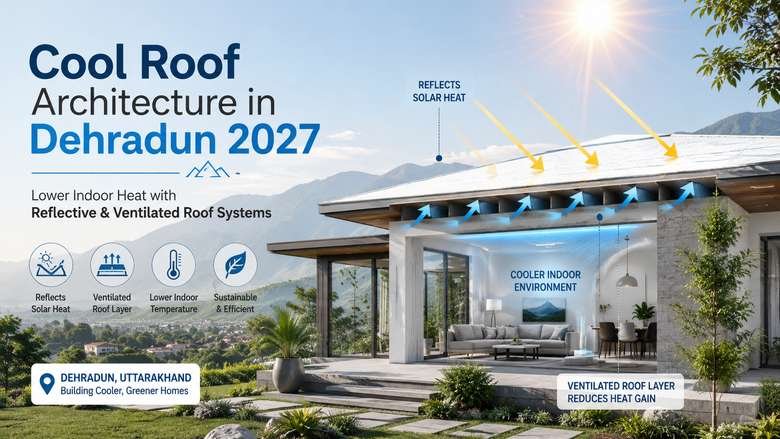
Cool Roof Architecture in Dehradun 2027: Lower Indoor Heat with Reflective & Ventilated Roof Systems
The roof of a house may represent only one part of its architecture, but during strong sunshine it can become one of the building surfaces most exposed to solar radiation.
For homeowners living directly below a poorly designed roof, the effect can become obvious. Upper-floor bedrooms may remain warm long after sunset, air conditioners may need to operate for longer periods, and terraces can become uncomfortable during the hottest hours of the day.
Cool Roof Architecture in Dehradun aims to reduce this problem before it begins.
Instead of treating the roof merely as a waterproof slab or decorative architectural element, a cool-roof strategy considers how much solar energy the roof absorbs, how effectively it releases heat, how much heat moves through the roof assembly and whether air can be used to reduce heat accumulation in suitable roof systems.
The Bureau of Energy Efficiency’s Eco-Niwas Samhita 2024 describes a cool roof as a surface that reflects a substantial portion of incident solar radiation and efficiently emits absorbed heat back into the atmosphere rather than conducting it into the building. The code also identifies coatings, colours, tiles, broken-China mosaic and certain metal finishes among possible cool-roof approaches.
For homes being planned in 2027, Cool Roof Architecture in Dehradun can therefore become an important component of climate-responsive residential design.
But the strongest solution is rarely “paint the roof white and finish.”
Roof reflectance, insulation, ventilation, waterproofing, solar panels, drainage and architecture need to work together.
What Is a Cool Roof?
A cool roof is designed to remain cooler under solar exposure than a comparable conventional dark or highly absorptive roof.
Two material properties are especially important.
The first is solar reflectance: how much incoming solar radiation a surface reflects instead of absorbing.
The second is thermal emittance: how effectively the material releases absorbed heat as thermal radiation.
BEE’s ENS 2024 identifies both properties as fundamental to roof “coolness.” The document also explains Solar Reflectance Index, or SRI, as a combined measure used to indicate how hot a roof surface is likely to become relative to standard black and white reference surfaces.
This makes Cool Roof Architecture in Dehradun more technical than simply selecting a pale colour.
Colour matters, but tested roof performance matters more.
What Is Solar Reflectance Index or SRI?
Solar Reflectance Index combines the effects of solar reflectance and thermal emittance into one performance indicator.
In practical terms, a roof material with strong solar reflection and heat-emission characteristics can generally maintain a lower surface temperature under sunlight than a highly absorptive material.
ENS 2024 notes that ECBC 2017 cool-roof requirements for roofs with slopes below 20 degrees reference an initial solar reflectance of at least 0.6 and initial emittance of 0.9.
For Cool Roof Architecture in Dehradun, homeowners should therefore ask suppliers for technical product information rather than selecting coatings only according to marketing claims such as “heat proof” or “summer proof.”
The architect should also confirm which standards and requirements apply to the actual residential project in 2027.
Why Cool Roof Architecture in Dehradun Matters
Roof exposure is particularly important for rooms directly below terraces or upper roofs.
When solar radiation is absorbed by a roof, part of that energy raises the temperature of the roof surface and can subsequently transfer through the roof assembly.
The exact indoor impact depends on roof construction, insulation, thermal mass, shading, ventilation, occupancy and weather.
This means Cool Roof Architecture in Dehradun should not be considered independently from the complete building envelope.
Heritage Architects already recommends roof insulation, ventilated roof spaces and heat-reflective finishes as part of passive cooling design for Dehradun residences.
A dedicated cool-roof strategy develops those principles in greater detail.
Reflective Roofs Can Reduce Solar Heat Absorption
One of the simplest cool-roof strategies is increasing surface reflectance.
Light-coloured or specially formulated reflective finishes can reject a greater portion of solar radiation than many dark surfaces.
This may reduce roof surface temperature and subsequently reduce the heat that must be managed by the roof assembly.
The U.S. Department of Energy similarly identifies high solar reflectance and high thermal emittance as key characteristics when selecting cool-roof products.
For Cool Roof Architecture in Dehradun, reflective systems can include suitable coatings, roof tiles or other tested finishing products.
However, performance should be evaluated according to the complete roof—not merely the top coating.
Reflective Paint Alone Is Not a Complete Roof Strategy
A homeowner may ask the contractor to apply a reflective coating and expect the upper floor to become completely cool.
That expectation is often unrealistic.
The roof remains affected by:
roof material, slab thickness, insulation, waterproofing, thermal bridges, ceiling construction and air-conditioning conditions.
This is why ENS 2024 explicitly states that a cool roof should not replace the roof’s required thermal-transmittance performance. Instead, cool-roof treatment is encouraged over an appropriately performing roof assembly.
A better Cool Roof Architecture in Dehradun strategy therefore combines reflection with resistance to heat transfer.
Roof Insulation Controls Heat Transfer
Reflective surfaces attempt to reduce how much solar energy the roof absorbs.
Insulation addresses another problem: how easily heat moves through the roof assembly.
These strategies complement one another.
In Cool Roof Architecture in Dehradun, the architect can evaluate insulation according to roof type, construction system and project requirements.
Possible locations may include insulation above or below structural elements depending on the roof assembly.
The correct detailing matters.
Insulation that is poorly installed, discontinuous or exposed to moisture may not perform as intended.
H4: Reflection Works at the Exterior Surface
The outer roof layer attempts to reject solar energy.
H5: Insulation Works Through the Roof Assembly
The insulation layer reduces heat transmission toward indoor spaces.
H6: Interior Comfort Depends on the Complete System
Neither treatment should be considered in isolation. The most effective Cool Roof Architecture in Dehradun considers reflectance, insulation, waterproofing and construction quality together.
What Is a Ventilated Roof System?
Another strategy is creating a ventilated air space within or below a roof assembly.
Instead of allowing solar-heated roofing material to transfer heat directly toward the occupied room, a cavity separates the external roof from the internal building envelope.
Openings positioned appropriately can allow heated air within the cavity to move out.
This principle is common in several types of double-roof and ventilated-roof construction.
For Cool Roof Architecture in Dehradun, ventilated systems can be particularly relevant to sloped roofs or architectural roofs where a secondary weather-protective layer can be separated from the insulated ceiling or structural roof below.
How Does a Ventilated Roof Reduce Heat?
Solar radiation heats the external roof surface.
That outer material then transfers heat to the adjacent environment.
If an air cavity exists underneath, part of this heat enters the cavity instead of immediately reaching the occupied interior.
As cavity air warms, intentionally positioned ventilation openings can support air movement.
The resulting system can help limit heat accumulation when it is correctly designed.
However, Cool Roof Architecture in Dehradun requires careful detailing because ventilation openings must also account for rain, insects, debris and local construction conditions.
A poorly designed roof cavity can create moisture or maintenance problems instead of solving heat gain.
Sloped Roofs Offer Interesting Passive-Cooling Opportunities
Sloped roofs are visually compatible with many contemporary and regional residential designs.
They can also support roof ventilation and effective rainwater drainage.
Heritage Architects’ sustainable design content already identifies sloping roofs as useful for managing heavy rainfall and rainwater harvesting in Dehradun.
In Cool Roof Architecture in Dehradun, a sloped roof can potentially combine several functions:
solar protection, ventilation cavity, insulation, waterproofing, drainage and rainwater collection.
The outer material should still be selected according to thermal behaviour and durability rather than appearance alone.
Dark Metal Roofs Need Careful Thermal Planning
Metal roofing can create elegant modern forms and is practical for certain sloped-roof designs.
But unprotected dark metal can become hot under direct sunlight.
DOE guidance notes that high reflectance and high emittance are important for cool-roof performance and cautions that unpainted metal may not deliver the same high-emittance performance as suitable finished systems.
For Cool Roof Architecture in Dehradun, metal roofs can therefore benefit from appropriate coatings, insulation and ventilated separation from occupied interiors.
Material selection should respond to performance, aesthetics and rainfall detailing together.
Flat Terrace Roofs Need a Different Strategy
Many Dehradun residences use reinforced-concrete terrace roofs.
These provide accessible roof space but receive substantial direct solar exposure.
A flat-roof Cool Roof Architecture in Dehradun strategy may consider a combination of:
reflective finish, thermal insulation, proper waterproofing, drainage and shading.
Depending on the project, tiles or other roof finishes may also contribute to the external performance.
The roof must remain serviceable and water-resistant throughout its life.
Thermal improvements should never compromise waterproofing.
Waterproofing Must Come Before Cosmetic Cool-Roof Treatment
A roof that reflects sunlight but leaks during monsoon is not a successful sustainable roof.
This is especially important in Dehradun.
Before applying coatings or terrace treatments, the architect should coordinate:
surface slopes, drainage outlets, waterproofing upstands, parapet junctions, pipe penetrations and expansion details.
For Cool Roof Architecture in Dehradun, thermal and moisture performance need to be designed as one assembly.
Randomly applying multiple incompatible layers can create adhesion or waterproofing problems.
Reflective Tiles Can Be Another Option
Roof tiles or tile-based terrace finishes can potentially provide reflective and protective surfaces.
The actual benefit depends on their tested solar reflectance, thermal emittance and complete roof construction.
A visually white tile is not automatically a high-performance product.
For Cool Roof Architecture in Dehradun, technical specification should accompany aesthetic selection.
Homeowners should also consider slip resistance, maintenance and terrace usage where the roof is accessible.
What About Traditional Broken-China Mosaic Roofs?
Broken-China mosaic has historically been used as a reflective roof finish in parts of India.
ENS 2024 specifically includes broken-China mosaic among examples of cool-roof applications.
Such systems can create a light, reflective surface while protecting the terrace.
However, installation quality, waterproofing compatibility, joints and long-term maintenance remain important.
A Cool Roof Architecture in Dehradun project should evaluate traditional and contemporary solutions based on measurable performance and construction practicality.
Roof Gardens Can Provide Additional Protection
Vegetated roofs are another strategy discussed alongside cool roofs in ENS 2024.
A green roof can shade the underlying roof surface and influence heat transfer.
It can also contribute to stormwater management and landscape value.
However, roof gardens introduce additional requirements:
structural load, waterproofing, root barriers, drainage, irrigation and maintenance.
For Cool Roof Architecture in Dehradun, a roof garden should therefore be engineered from the beginning.
It should never be added casually to an existing slab without structural evaluation.
Solar Panels Can Shade Part of the Roof
Rooftop photovoltaic panels can indirectly shade areas of the roof beneath them.
This can reduce direct solar exposure on those portions.
But a solar array should not be treated as a substitute for complete roof thermal design.
A future-ready Cool Roof Architecture in Dehradun can coordinate solar panel layout with:
roof finish, waterproofing, maintenance access, water tanks and service areas.
Leaving suitable airflow around the panel system can also support equipment performance according to the manufacturer’s installation requirements.
Solar Panels and Reflective Roofs Can Be Planned Together
Solar and cool roofs do not have to compete.
The roof can be divided into functional zones.
Some areas may carry photovoltaic modules.
Accessible zones may use reflective finishes.
Service areas may require different treatments.
For Cool Roof Architecture in Dehradun, all rooftop systems should be coordinated during architectural planning so future solar installation does not damage waterproofing or block drainage.
Parapet Design Can Affect Roof Shading
Parapets and rooftop structures create shadows across parts of the terrace.
Water tanks, stair-head rooms and solar equipment also change solar exposure.
A detailed architectural model can help understand these relationships.
In advanced Cool Roof Architecture in Dehradun, sun-path analysis or building-performance simulation can compare different roof configurations before construction.
This allows the roof to be treated as part of the complete environmental design.
Cool Roofs and Building Performance Simulation
Building performance simulation can estimate how changes to the roof influence cooling loads and indoor thermal conditions under defined assumptions.
An architect can compare:
a conventional roof, an insulated roof, a reflective roof, or a combined insulated-and-reflective system.
This is particularly useful for premium Cool Roof Architecture in Dehradun projects where homeowners want evidence-based design decisions.
Simulation does not guarantee real-world results, but it can improve comparisons between options.
Cool Roofs Can Support Passive Cooling
Cool roofs work best as part of a wider passive-cooling strategy.
The rest of the house still matters.
A well-designed project can combine:
orientation, external shading, cross ventilation, appropriate glazing, roof insulation and landscape shading.
Heritage Architects’ current passive-cooling guidance already emphasizes these measures together rather than presenting any single treatment as a complete solution.
That approach is central to Cool Roof Architecture in Dehradun.
Don’t Ignore Heat Coming Through Windows and Walls
Improving the roof cannot compensate for every other thermal weakness.
A west-facing bedroom with excessive unshaded glazing may still become warm even beneath a high-performance roof.
BEE’s ENS 2024 uses Residential Envelope Transmittance Value to characterize heat gain through non-roof portions of the residential envelope and links lower envelope heat gain with improved comfort and reduced cooling electricity.
This reinforces the whole-building approach.
Cool Roof Architecture in Dehradun should therefore be coordinated with walls, windows and shading.
Light-Coloured Roofs Are Not Automatically Maintenance-Free
Reflective performance can change over time as roofs collect dust, pollution, biological growth or surface wear.
DOE guidance notes that the endurance of high reflectance matters and recommends periodic roof inspection and appropriate maintenance or cleaning.
For Cool Roof Architecture in Dehradun, maintenance access should therefore be considered during planning.
Water tanks, solar systems and roof equipment should not make important areas impossible to inspect.
Monsoon Dirt and Organic Growth Can Affect Reflectance
Rain can wash some roof surfaces, but moisture can also contribute to algae or biological growth under certain conditions.
Leaves and debris may accumulate near drains or shaded areas.
A roof maintenance plan should include cleaning, drainage inspection and checks around waterproofing.
The long-term success of Cool Roof Architecture in Dehradun depends on maintaining both thermal and moisture performance.
Winter Performance Should Also Be Considered
Cool roofs are primarily intended to reduce unwanted heat gain.
But a highly reflective roof can also reduce beneficial solar heat absorption during cooler conditions.
DOE notes that cool roofs generally produce their greatest cooling-energy benefit in hot climates and may introduce a winter heating penalty in colder climates.
This is relevant to Dehradun because residential design needs to consider both warmer and cooler periods.
The correct Cool Roof Architecture in Dehradun strategy should therefore be based on annual building performance rather than only peak summer conditions.
This is another reason insulation is valuable: insulation helps moderate heat transfer in both directions.
Is a White Roof Always the Best Roof?
Not necessarily.
White surfaces often have high solar reflectance, but colour alone does not tell the complete performance story.
Specialized products may achieve useful solar reflectance in other colours.
Architectural appearance, glare, maintenance, SRI and material durability should all be considered.
For Cool Roof Architecture in Dehradun, tested performance data is more useful than assumptions based purely on colour.
Cool Roof Planning for Bedrooms on the Top Floor
Top-floor bedrooms are among the spaces most likely to benefit from thoughtful roof design.
The architect can coordinate:
roof insulation, ceiling strategy, external finish and ventilation where appropriate.
For Cool Roof Architecture in Dehradun, it is useful to evaluate bedroom comfort during the design stage instead of waiting until the first summer after occupancy.
This may also reduce the need to compensate later with larger cooling equipment.
Cool Roof Planning for Double-Height Spaces
Double-height spaces may have complex roof geometry.
Skylights, clerestory windows and sloped roofs can produce impressive architecture while introducing thermal challenges.
The roof and glazing should therefore be studied together.
A Cool Roof Architecture in Dehradun concept might use insulated roof planes, protected skylights, external shading and ventilated cavities to maintain visual drama without unnecessary heat gain.
Existing Homes Can Also Use Cool-Roof Retrofits
Cool-roof strategies are not limited to new buildings.
Existing homes with uncomfortable top floors may be evaluated for retrofit options.
Professionals should first inspect:
waterproofing, roof condition, drainage, existing finish and structural constraints.
Depending on the building, a retrofit Cool Roof Architecture in Dehradun strategy may involve reflective coatings, improved insulation, shading or another suitable roof treatment.
A site assessment should come before product purchase.
Common Cool Roof Design Mistakes
One frequent mistake is believing reflective paint alone will solve every top-floor heat problem. Another is adding insulation without coordinating waterproofing. Dark metal roofing may be installed directly above occupied spaces without sufficient thermal separation, while roof cavities are sometimes created without proper ventilation paths. Solar panels may be added later in ways that damage waterproofing or obstruct drains.
Another common mistake is selecting a product because the surface appears light without checking solar reflectance, thermal emittance or SRI data. Finally, homeowners sometimes design only for summer and ignore annual thermal performance.
Cool Roof Architecture in Dehradun should avoid these shortcuts and treat the roof as an integrated environmental system.
A Practical Cool Roof Roadmap for 2027
The process should begin with roof type and solar exposure. The architect should decide whether the house requires a flat terrace, sloped roof, double roof or hybrid system.
Next, the complete thermal assembly should be developed. Appropriate insulation should be considered alongside waterproofing and drainage.
The external roof finish can then be selected based on solar reflectance, emittance, SRI, durability and aesthetics.
Where a ventilated roof is planned, the cavity, inlet and outlet strategy should be properly detailed while protecting against rain and pests.
Solar-panel zones, water tanks and maintenance paths should be coordinated before construction.
Finally, the architect should verify that execution follows the specified roof build-up.
This sequence turns Cool Roof Architecture in Dehradun from a last-minute coating into a planned architectural solution.
Why Architects Are Important for Cool Roof Planning
The roof affects more systems than homeowners often realize.
It influences thermal comfort, waterproofing, drainage, solar energy, rainwater harvesting, exterior appearance, structure and maintenance.
An architect can coordinate these requirements instead of allowing each contractor to solve their part separately.
Heritage Architects already connects passive cooling with roof insulation, reflective finishes, ventilation, shading and climate-responsive planning in its current Dehradun content.
This integrated approach is particularly relevant to Cool Roof Architecture in Dehradun because roof performance depends on the complete assembly.
FAQs About Cool Roof Architecture in Dehradun
What is a cool roof?
A cool roof is designed to reflect a significant amount of incoming solar radiation and efficiently release absorbed heat, helping the roof remain cooler under sunlight than a more absorptive surface.
What is SRI in roofing?
SRI stands for Solar Reflectance Index. It combines solar reflectance and thermal emittance to describe how a surface is expected to respond to solar heating.
Does a cool roof replace insulation?
No. ENS 2024 explicitly states that cool roofs should not be treated as an alternative to prescribed roof thermal-transmittance performance.
Can reflective roof coatings reduce indoor heat?
They can reduce the solar energy absorbed at the roof surface, which may reduce heat transfer into the building. Actual indoor impact depends on the complete roof assembly and building conditions.
Is a ventilated roof useful for Dehradun homes?
It can be useful in suitable architectural systems when the cavity, ventilation, rain protection and insulation are correctly designed.
Is a white roof always required?
No. Performance depends on solar reflectance, thermal emittance and SRI, not colour alone.
Can solar panels be installed on a cool roof?
Yes. Cool Roof Architecture in Dehradun can coordinate solar panels with reflective surfaces, insulation, waterproofing and maintenance access.
Can a cool roof help reduce AC use?
Potentially. Reducing roof heat gain can reduce cooling demand, particularly for spaces directly below the roof, but total HVAC use also depends on walls, windows, occupancy and system efficiency.
Can an existing terrace be converted into a cool roof?
Often yes, depending on existing waterproofing, roof condition and construction. The roof should be professionally inspected before selecting a retrofit treatment.
Does the cool-roof surface need maintenance?
Yes. Dirt and weathering can affect reflective performance, so periodic inspection and appropriate maintenance are important.
Conclusion: Stop Heat at the Roof Before Cooling It Indoors
The most efficient heat to remove from a home is often the heat that never enters in the first place.
That is the central principle behind Cool Roof Architecture in Dehradun.
Reflective finishes can reduce solar absorption.
High-emittance surfaces can release absorbed heat more effectively.
Insulation can reduce heat transmission through the roof assembly.
Ventilated roof cavities can create another layer between solar-heated roofing and occupied interiors.
Shading and rooftop solar can further influence roof exposure.
But no single treatment should be treated as a magic solution.
The strongest cool roof combines reflectance + insulation + ventilation where appropriate + waterproofing + drainage + maintenance.
This approach is directly supported by BEE’s ENS 2024, which explains cool roofs while specifically cautioning that they should complement rather than replace roof thermal-transmittance requirements.
For homeowners building in 2027, Cool Roof Architecture in Dehradun can therefore become a practical part of a wider passive-cooling strategy.
Heritage Architects can coordinate cool-roof finishes, roof insulation, ventilated roof systems, solar-ready planning, rainwater drainage and climate-responsive architecture from the initial design stage.




Leave a Reply